About this issue
Why this chart.
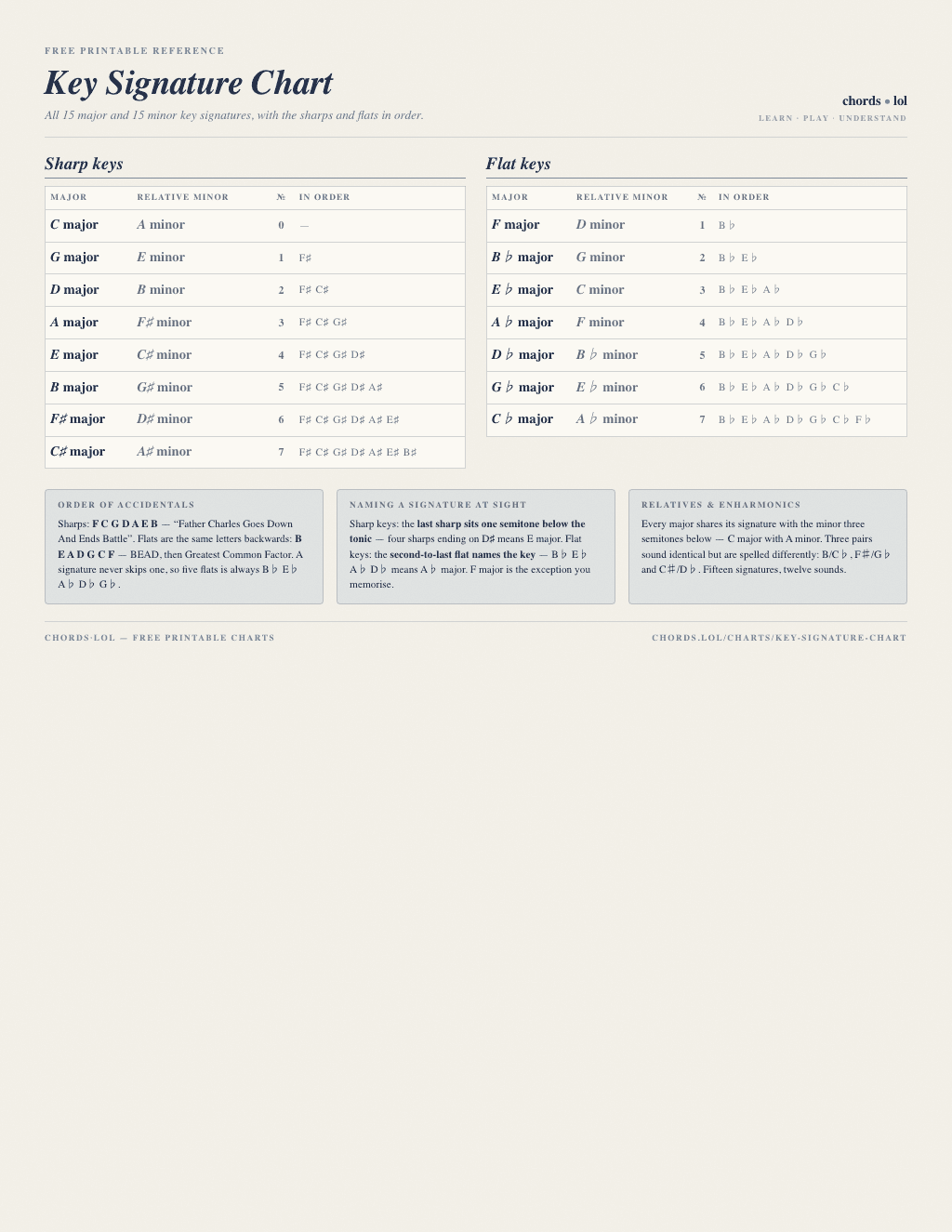
A key signature is the shorthand printed at the start of a stave: a small group of sharps or flats declaring that these notes are altered for the whole piece so nobody has to write an accidental every bar. This chart lays out all fifteen major key signatures and their fifteen relative minors, with the accidentals in the fixed order they always appear, the count for each key, and the relative pair on the same row.
The order is not arbitrary and never varies. Sharps always arrive F♯, C♯, G♯, D♯, A♯, E♯, B♯ — each one a fifth above the last. Flats arrive in exactly the reverse: B♭, E♭, A♭, D♭, G♭, C♭, F♭. That means a key signature is fully determined by its count. Three sharps can only be F♯, C♯, G♯, which can only be A major or F♯ minor. Once you trust the order you never need to read the individual symbols, only count them.
Two shortcuts follow, and both are on the sheet. For a sharp key, the last sharp sits one semitone below the tonic: four sharps ending on D♯ means E major. For a flat key, the second-to-last flat names the key outright: B♭ and E♭ means B♭ major. Learn those two and you can name any signature at a glance instead of reciting the circle from C.
Fifteen rather than twelve, because three keys are spelled two ways. B major and C♭ major sound identical on a keyboard but one is written with five sharps and the other with seven flats. Which spelling a composer chooses depends on where the music is heading and what is easiest to read. All three enharmonic pairs — B/C♭, F♯/G♭, C♯/D♭ — are printed side by side so the equivalence is obvious rather than confusing.
How to use it
Reading a piece: count the sharps or flats after the clef, find that count in the chart, and take the major key from the left column or the minor from the right — the surrounding melody and the final chord will tell you which of the pair it is. Writing in a key: read the row the other way for the exact accidentals to put in the signature, in the printed order. The relative-minor column pairs every major with the minor sharing its notes, three semitones below.