About this issue
Why this chart.
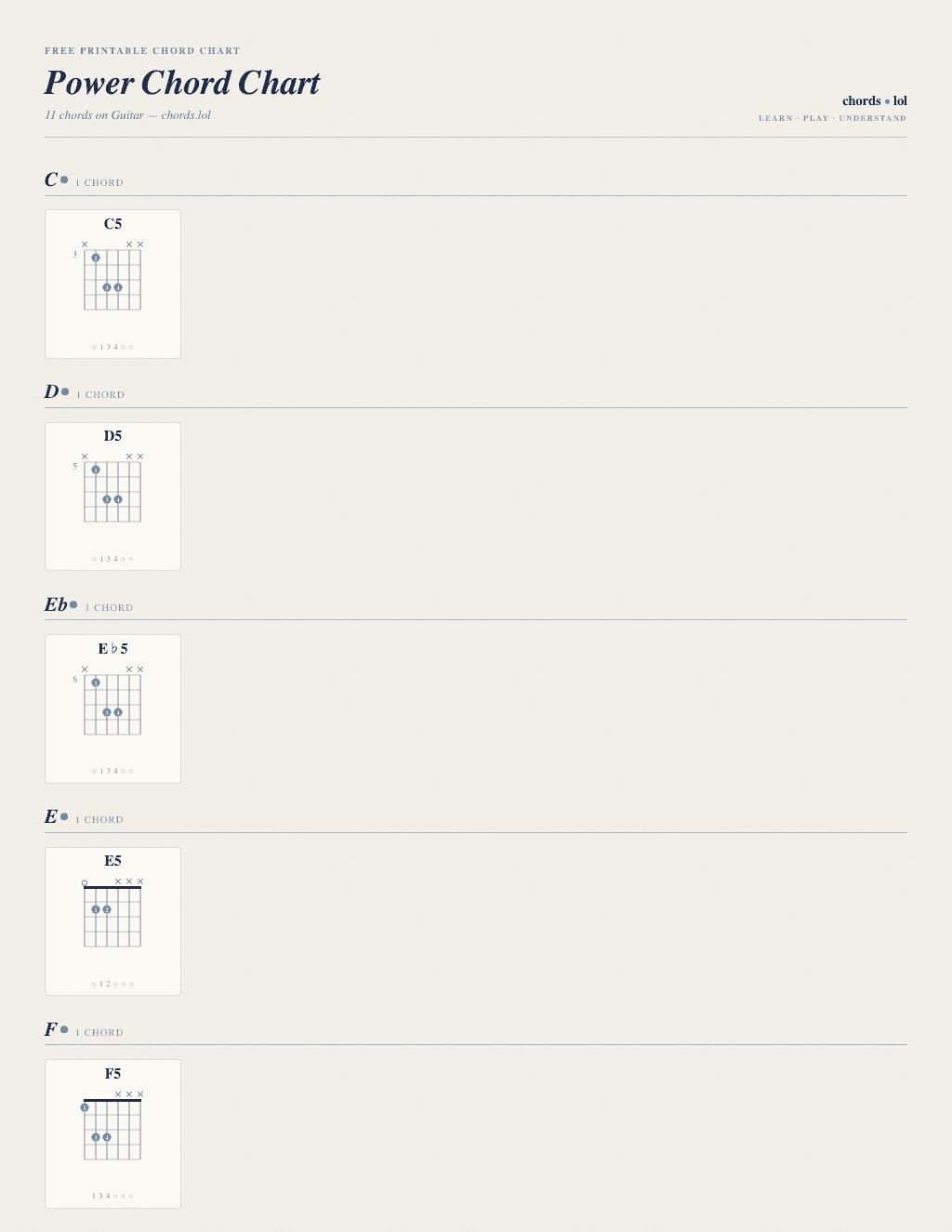
Power chords are two-note dyads — root and fifth, no third. The third is what makes a chord sound major or minor; without it, you get a punchy, ambiguous, distortion-friendly sound that's the foundation of rock, metal, and punk.
Power chords are moveable. Once you know the shape, you can play any root by sliding up and down the low strings. They're the easiest 'real' chord to play and arguably the most influential shape in rock.
Through a clean amp, power chords sound thin. Through distortion, they suddenly reveal their reason for existing: the lack of a third means there's no harmonic conflict when you push the signal hard, and the chord stays clear instead of turning to mud.
How to use it
Anchor your index finger on the root. The fifth lives one string up and two frets higher (for the standard 6th-string-root shape). The optional octave lives one more string up and two frets higher. Practice power-chord progressions like I-♭VII-IV (Smoke on the Water).