chordslol

Issue №18 · chords·lol

Part of the free Guitar Chord Chart

Guitar Capo Chart

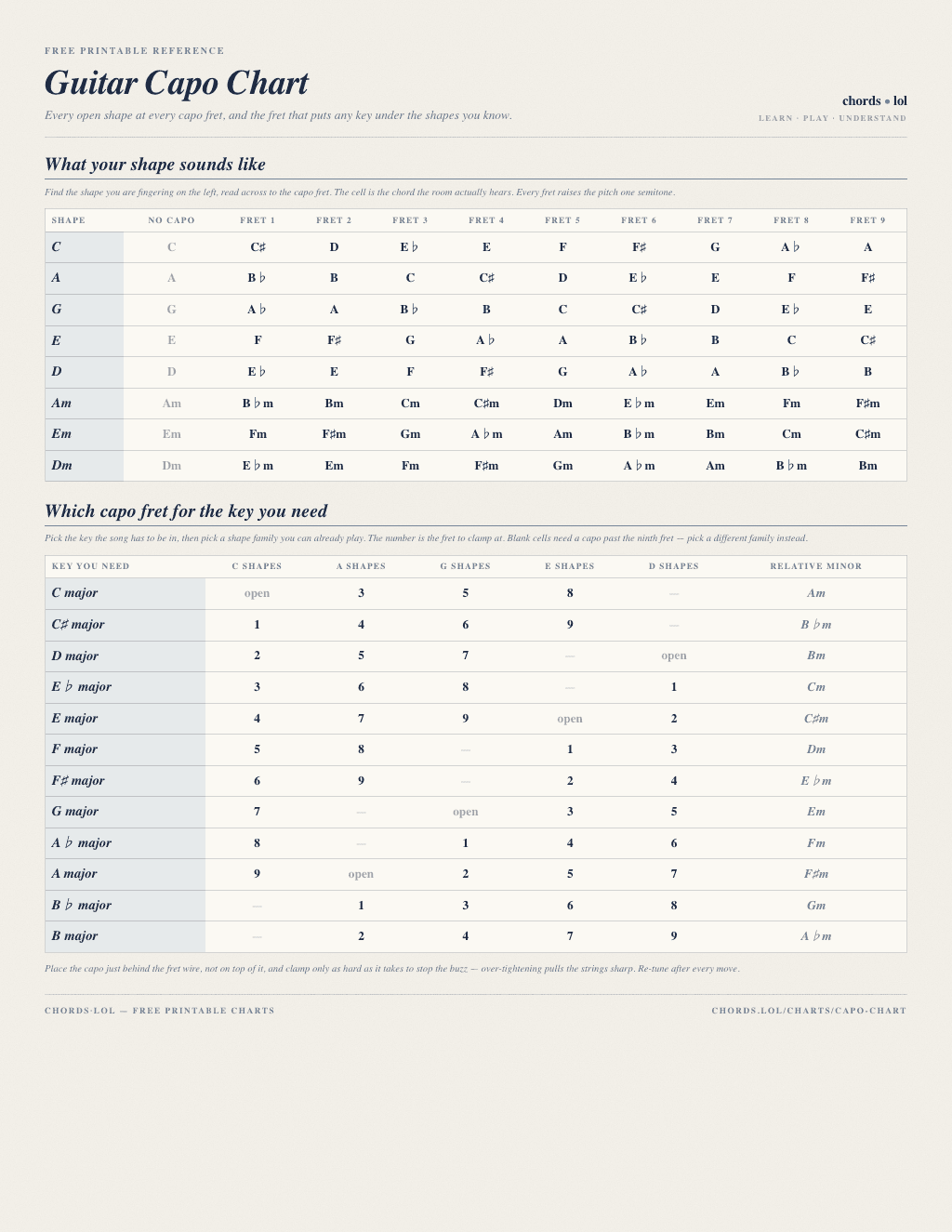
Capo transposition chart: what every open shape sounds as at each capo fret, plus which capo position plays any key with open chords.

↓ Download the Guitar Capo Chart PDFFree, no email gate · single-ink, vector

License: free to share, free to teach with.

chords·lol

Charts

Guitar Capo Chart

Capo transposition chart: what every open shape sounds as at each capo fret, plus which capo position plays any key with open chords.

Issue №18 · 18 of 19 in the series

chords.lol/charts/capo-chart

About this issue

Why this chart.

A capo is a clamp that shortens every string at once, and the entire point of it is that your hands keep doing something easy while the guitar produces something hard. Put the capo at the third fret, play the shape you know as C, and a listener hears E♭. This chart is the lookup table for that trade: eight familiar open shapes down the side, capo frets zero through nine across the top, and the chord that actually sounds in every cell.

That is the half of the capo question most players ask first — "I have the capo on, what am I playing?" The second table on the sheet answers the reverse and more useful question: your singer needs the song in B, which capo fret lets you play it with open chords? Read down the key column, find the row where the shapes turn into ones you know, and clamp there. Countless songs that look unplayable in their written key are three open chords plus a capo at the right fret.

The maths behind every cell is a single rule: each fret raises the sounding pitch one semitone. Capo 2 with a G shape sounds A. Capo 5 with an E shape sounds A as well — the same chord from a different shape, in a different register, with a different string ringing on top. That last part is why capos are a tone decision and not only a convenience one. Two guitarists playing the same progression from different capo positions is one of the oldest arrangement tricks there is.

Nothing on this page needs a chord diagram, which is why it prints as a dense, legible grid rather than a wall of fretboards. Tape it inside a gig folder or the lid of a case. It is the reference you want at the exact moment there is no time to work anything out.

How to use it

To find what you are playing: pick your shape's row, run across to your capo fret, read the sounding chord. To find where to put the capo: use the second table, find the key you need, and clamp at the fret listed — then play the shapes in that row as written. Place the capo just behind the fret wire, not on top of it, and press only as hard as it takes to stop the buzz; over-tightening pulls the strings sharp and no amount of tuning fixes that.

From the editor: Issue №18 is one of 19 in the chords·lol library series. New issues are added monthly.

License: the PDF and its diagrams are CC-BY 4.0. Reproduce freely. Credit appreciated.

Print quality: sRGB, vector. Suitable for home laser, inkjet, and copy-shop reproduction.

Companion: see all 19 issues in the library.

Try it before you print it

The same chart, on screen, audio-enabled.

Open the full-size guitar capo chart preview in its own tab — it is the same page the PDF is printed from.

Download the guitar capo chart

2 files · free, ungated, no watermark

Common questions

  • What does a capo actually do?

    It bars every string at one fret, which raises the pitch of all six by the same number of semitones and gives you a new set of open strings. The instrument is effectively re-tuned upward, so your familiar first-position shapes produce chords in a higher key without your fingers changing anything.

  • Does a capo change the chord shapes I play?

    No — that is exactly the point. The shape stays whatever you already know; only its name changes. With a capo at fret 3, the C shape sounds E♭ but is still fingered as C. Players say "C shape" for the fingering and "sounding chord" for what the room hears, and this chart maps one to the other.

  • Which capo fret for the key of X?

    Count the semitones from an open key you can play to the key you need, and that is the fret. Key of B♭ from G shapes is three semitones, so capo 3. The second table on the chart does the counting for all twelve keys against the common shape families, so you can read the answer instead of working it out.

  • Does a capo work on electric guitar?

    Yes, and the same table applies. Electrics have lower action and lighter strings, so use the lightest clamping pressure that stops the buzz — a heavy capo on a low-action neck bends notes sharp fast. Check tuning after clamping, every time, on any guitar.

Related chord charts

Closest first — same instrument, then the rest of the 19-issue library.