chordslol

The Tools

Circle of Fifths

The single most useful diagram in Western music. Click any key to spin it to the top — you get its key signature, its relative minor, all seven of its chords, and the I-IV-V-I cadence played back to you. All 30 keys, and a free printable poster underneath.

CGDAEBF♯/GDAEBFAmEmBmF♯mC♯mG♯mD♯m/EmBmFmCmGmDmMAJORCno ♯ or ♭

Click a key to spin it to the top · arrow keys to move · Enter to hear the cadence

C Major. No sharps, no flats. Diatonic chords: C, Dm, Em, F, G, Am, Bdim.

Selected key

C Major

No sharps, no flats

Relative minor: A Minor · Parallel: C Minor

Scale: C · D · E · F · G · A · B

I – IV – V – I

I CIV FV GI C

Chords in C Major

Every chord links to its own diagram page.

Neighbouring keys

How to read it

Six things the wheel tells you.

01

Three rings, one glance

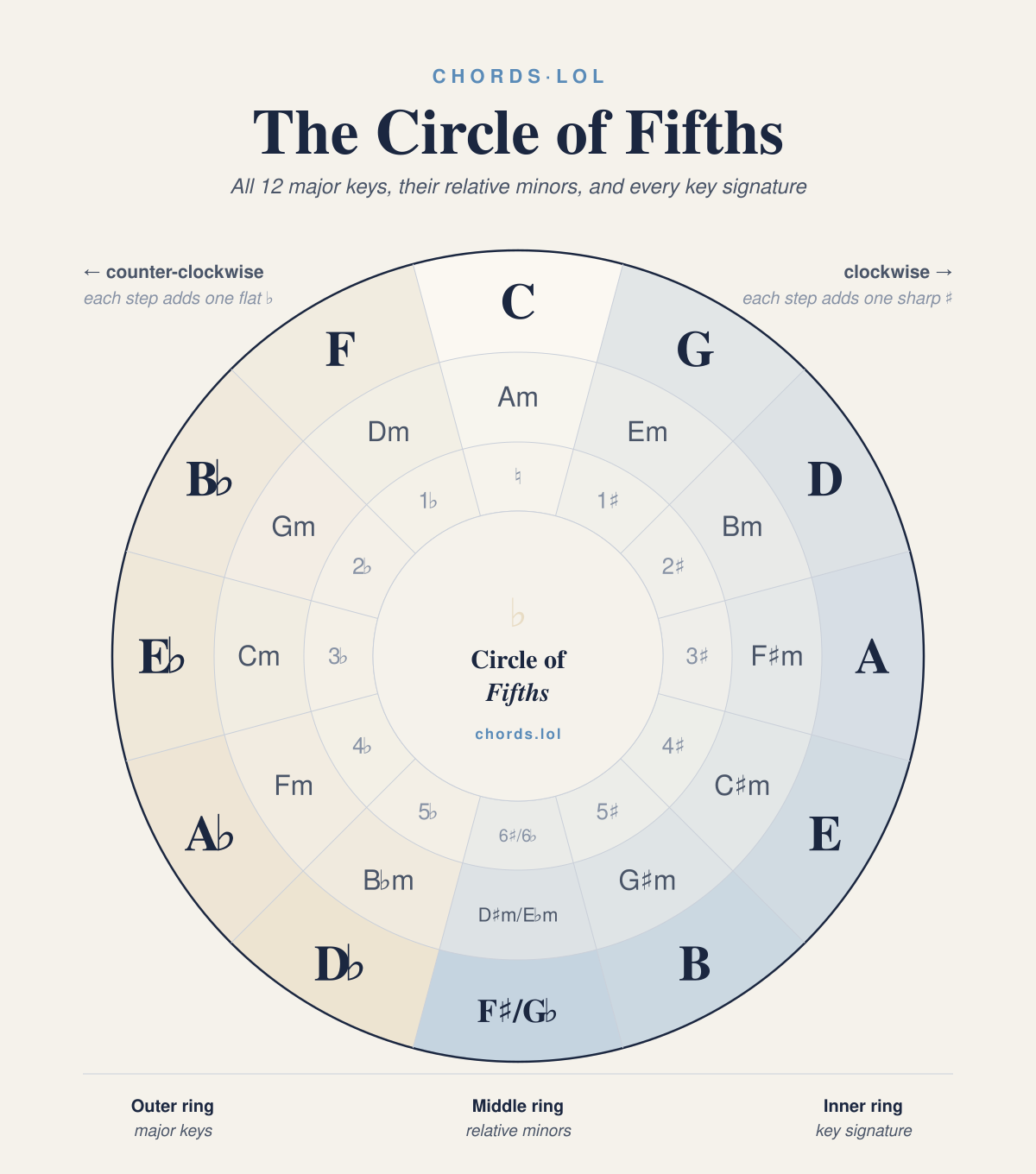
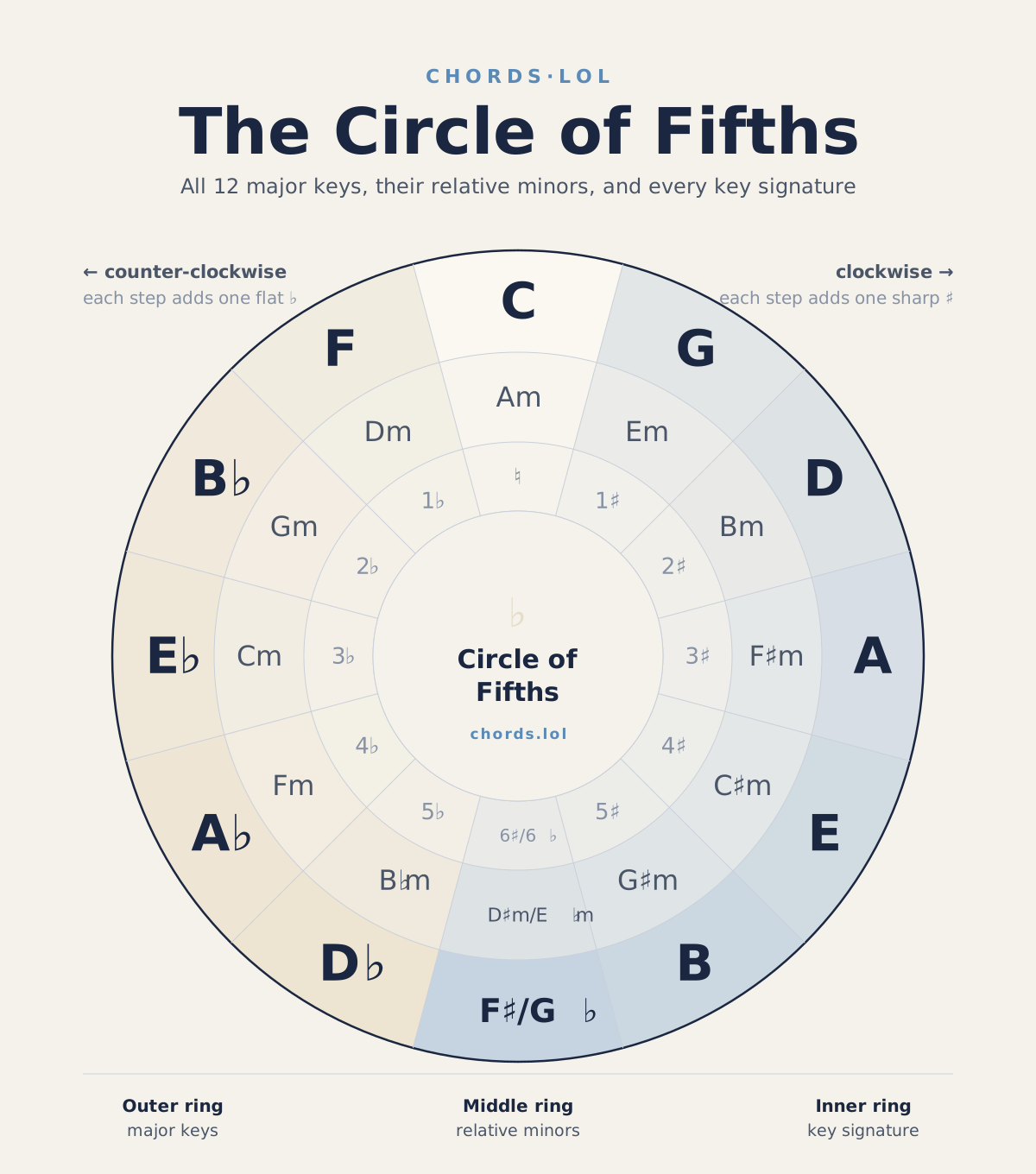
The outer ring holds the twelve major keys. The middle ring holds each one's relative minor — same seven notes, different home base. The inner ring tells you the key signature: how many sharps or flats you write after the clef. Read straight in from any major key and you get its minor twin and its signature in one move.

02

Clockwise adds a sharp, counter-clockwise adds a flat

Every step clockwise moves up a perfect fifth — C to G to D — and adds exactly one sharp. Every step counter-clockwise moves up a fourth — C to F to B♭ — and adds exactly one flat. That one-accidental-per-step rule is the whole reason the diagram is built on fifths rather than on any other interval, and it is why the twelve keys close into a circle instead of running off in a line.

03

Your neighbours are your other chords

Spin any key to the top of the wheel above and look either side: the key on the left is your IV, the key on the right is your V. Add the relative minor sitting directly beneath and you are holding I, IV, V and vi — the four chords behind an enormous share of popular music. In C that is C, F, G and Am. In G it is G, C, D and Em.

04

Relative minors share everything but the centre of gravity

A major key and the minor a third below it use identical notes and identical chords; only the resting note changes. That is why the wheel stacks them on the same spoke. Flip the widget to minor and the same twelve positions re-label themselves around the minor tonic, with the raised V that makes a minor cadence actually land.

05

Distance on the wheel is distance to the ear

Keys next to each other share six of their seven notes, so moving between them sounds smooth — that is why key changes in pop songs usually hop one or two steps. Keys on opposite sides share only two notes, which is why a leap across the circle sounds like a cinematic gear-change. Borrowed chords work the same way: the nearer the loan, the less it startles.

06

How to practise with it

Pick a key, play its I-IV-V-I, then move one step clockwise and do it again. Twelve laps and you have rehearsed every key in existence. Improvisers can use it as a map mid-solo: the chord tones live in the highlighted diatonic family, and the notes that add tension are the ones borrowed from further round the wheel.

Want the long version — the history, the maths behind the fifth, modal interchange and worked modulation examples? Read The Circle of Fifths, Explained.

Print it

The printable circle of fifths.

Full color-coded poster: all 24 keys, relative minors, key signatures, common modulations. Free, no email gate, no watermark — print it for a student, a classroom, or the wall above your piano.

Printable circle of fifths chart showing all 12 major keys, their relative minor keys, and the number of sharps or flats in each key signature
The chords.lol circle of fifths chart — free to save, print, and teach with.

Print-ready PDF

Letter, A4 and tabloid · vector · single-ink friendly

Chart image

Drop it into slides, a worksheet, or a lesson plan. Credit to chords.lol is appreciated, never required.

Key by key

All 30 keys, one click away.

Every key gets its own page: scale notes, the seven diatonic chords with diagrams, and the songs that live there.

Major keys

Minor keys

Keep going

TransposerMove a song to a key that fits your voiceScale ExplorerDrill the scale behind any keyChord FinderName the chord under your fingersEvery keyChord families, songs, and diagrams

FAQ

Common questions.

What is the circle of fifths?

The circle of fifths is a diagram that arranges the twelve musical keys in a ring, each one a perfect fifth above the last. Going clockwise (C, G, D, A…) adds one sharp to the key signature at every step; going counter-clockwise (C, F, B♭, E♭…) adds one flat. Because the arrangement is built on that single rule, it doubles as a map of key signatures, relative minors, chord families, and how closely any two keys are related.

How do I use the circle of fifths to find chords in a key?

Put your key at the top of the wheel. The key to its left is the IV chord, the key to its right is the V chord, and the relative minor directly beneath it is the vi. Those four — I, IV, V and vi — cover most popular songs. The remaining diatonic chords (ii, iii and the diminished vii°) are the minors sitting either side of your relative minor plus the note a half step below your tonic. The tool above lists all seven for whichever key you select and links each one to its own chord diagram.

Which way do you read the circle of fifths — clockwise or counter-clockwise?

Both, depending on what you want. Clockwise moves in fifths and adds sharps, so it is the direction to read when you are asking about key signatures or modulating brighter. Counter-clockwise moves in fourths and adds flats, and it is the direction chord progressions actually tend to travel: ii-V-I, the backbone of jazz, is three consecutive counter-clockwise steps, and the same falling-fifths motion drives everything from Baroque sequences to pop turnarounds.

What is a relative minor, and how do I find it on the circle?

A relative minor is the minor key that shares a major key's exact notes and key signature — A minor for C major, E minor for G major. On the circle it sits on the same spoke, one ring in. Musically it is the sixth degree of the major scale, which is why the vi chord feels like a mood shift rather than a key change.

Why do some positions show two names, like F♯ and G♭?

Because at the bottom of the circle the sharp side and the flat side meet. F♯ major (six sharps) and G♭ major (six flats) contain exactly the same pitches on a piano; they are simply written differently, and which spelling a score uses depends on the surrounding harmony and on what is easier to read. The same is true of D♭/C♯ and B/C♭.

Is there a printable circle of fifths?

Yes — the poster below is free, needs no email address, and comes in US Letter, A4 and tabloid sizes, plus PNG and SVG versions of the chart itself. All of them are single-ink and vector, so they stay crisp whether you print at home or blow one up for a classroom wall.