chordslol

Issue №12 · chords·lol

Circle of Fifths Poster

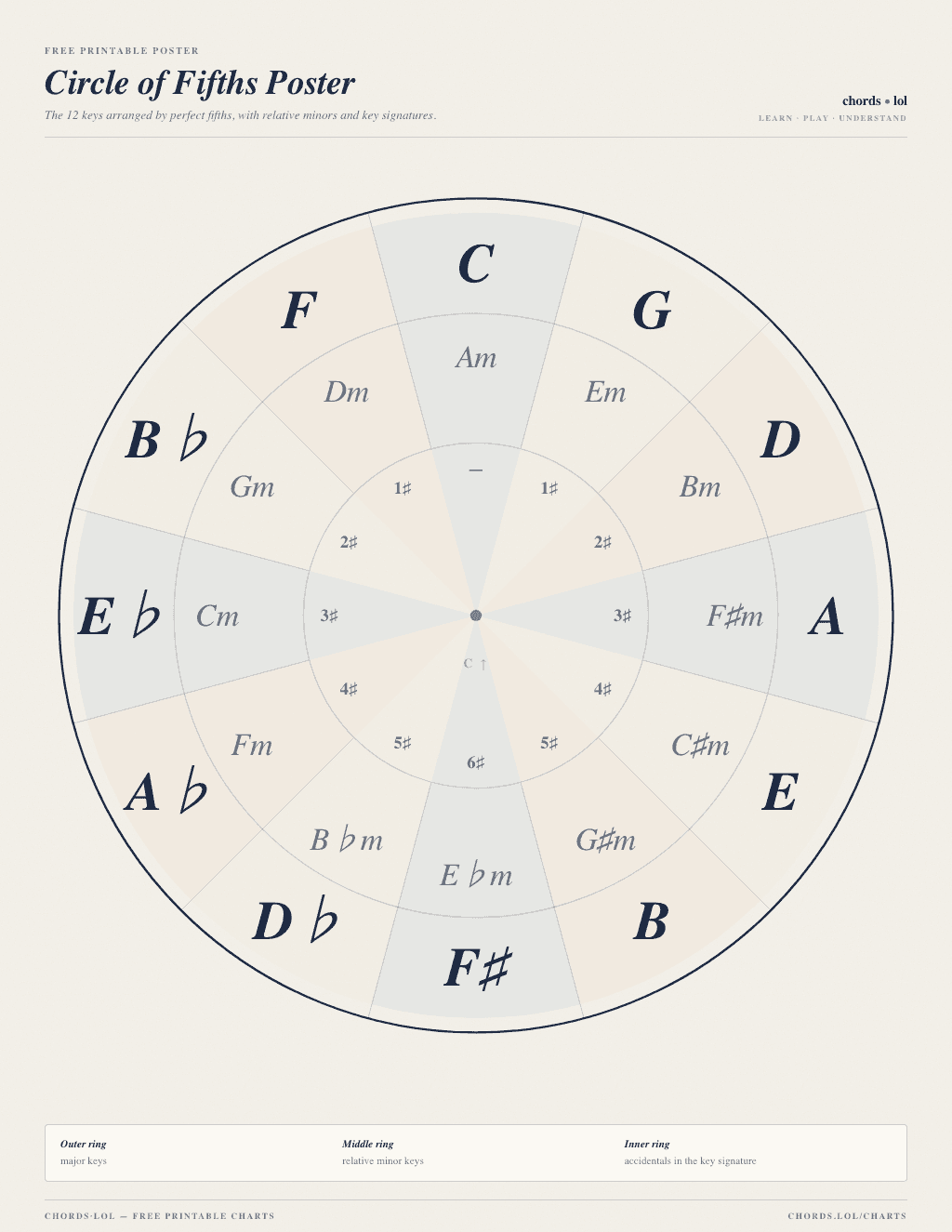
Full color-coded poster: all 24 keys, relative minors, key signatures, common modulations.

↓ Download the Circle of Fifths Poster PDFFree, no email gate · single-ink, vector

License: free to share, free to teach with.

chords·lol

Charts

Circle of Fifths Poster

Full color-coded poster: all 24 keys, relative minors, key signatures, common modulations.

Issue №12 · 12 of 16 in the series

chords.lol/charts/circle-of-fifths

About this issue

Why this chart.

The Circle of Fifths is the single most useful diagram in Western music theory. It maps the 12 keys onto a wheel, each one a perfect fifth (or seven semitones) clockwise from the previous. The result reveals why some keys feel related and others distant, and gives you instant answers to half the questions music theory raises.

Read the outer ring for major keys, the middle ring for relative minors, and the inner labels for key signatures. Two keys adjacent on the circle share six of seven scale notes. Two keys directly across (six positions apart, called tritone partners) share only two. That spatial logic mirrors how composers actually move between keys.

Print the circle as a poster. Tape it above your music stand. Within a month, you'll glance at it instead of consulting it — the spatial layout becomes a mental model you carry around.

How to use it

Find your starting key on the outer ring. Move clockwise one position to find the next-closest key (one more sharp). Move counter-clockwise to find one more flat. Drop to the middle ring at any position to find that key's relative minor.

From the editor: Issue №12 is one of 16 in the chords·lol library series. New issues are added monthly.

License: the PDF and its diagrams are CC-BY 4.0. Reproduce freely. Credit appreciated.

Print quality: sRGB, vector. Suitable for home laser, inkjet, and copy-shop reproduction.

Companion: see all 16 issues in the library.

Try it before you print it

The same chart, on screen, audio-enabled.

Open the full-size circle of fifths poster preview in its own tab — it is the same page the PDF is printed from.

Download the circle of fifths poster

3 files · free, ungated, no watermark

Common questions

  • Why fifths and not some other interval?

    Because going up by a fifth adds exactly one sharp (or removes one flat) to the key signature. No other interval has that property. The circle is essentially a map of how key signatures change.

  • What's a 'relative' minor?

    A minor key that uses the same notes as its major partner. C major and A minor both use the white keys only — they're relatives. The middle ring of the circle shows each major's relative minor.

  • Why do some chord progressions move clockwise around the circle?

    Because the V → I cadence (the strongest resolution in tonal music) is a counter-clockwise step. ii-V-I in jazz is three counter-clockwise steps.

Related chord charts

Closest first — same instrument, then the rest of the 16-issue library.