About this issue
Why this chart.
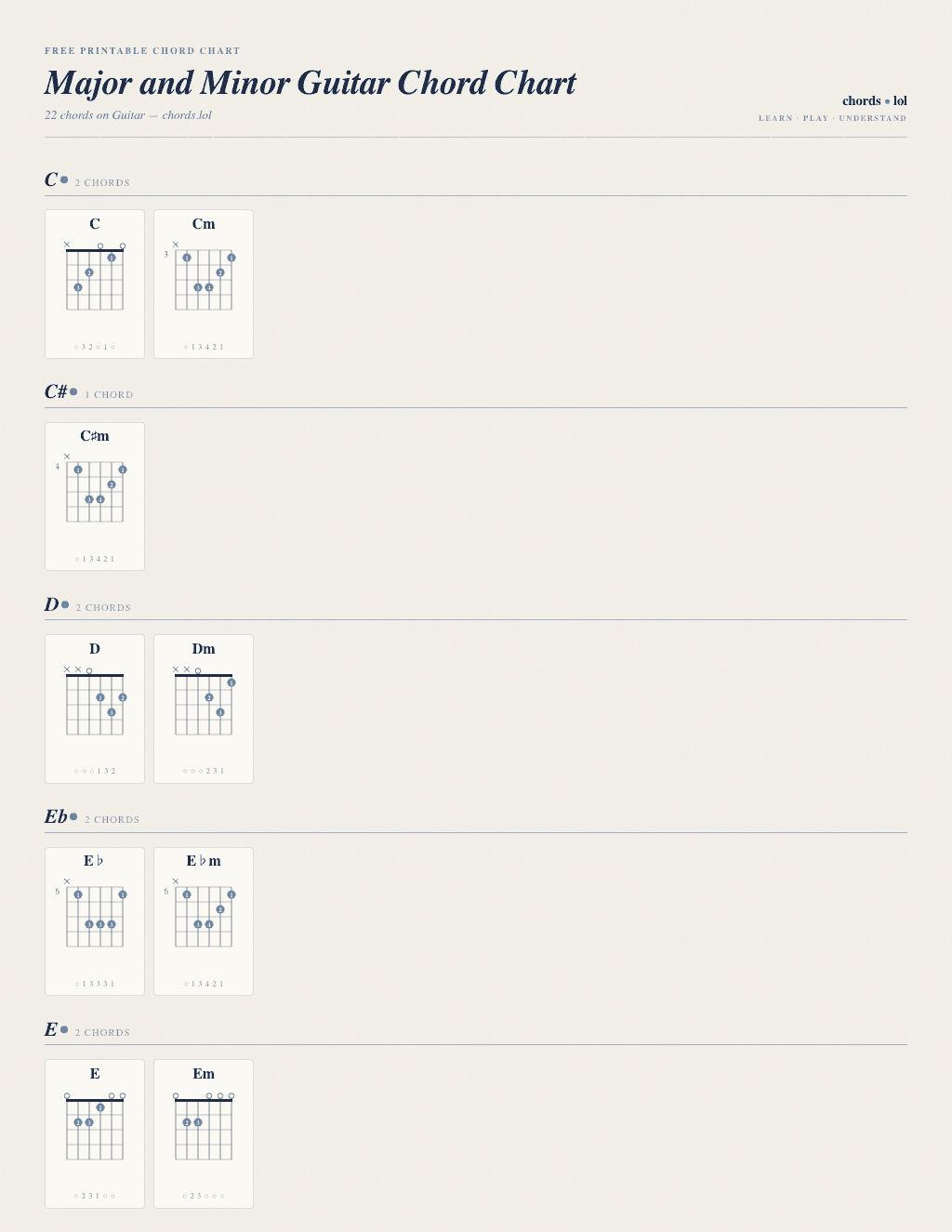
Twenty-four chords. That is the whole sheet: every major triad and every minor triad, one for each of the twelve roots, drawn full size with finger numbers in the dots. It is the smallest chart on the site that can still honestly claim to be complete, because major and minor between them account for the overwhelming majority of chord symbols in popular music.
The reason to keep major and minor together on one page — rather than splitting them the way most chord books do — is that they are the same shape with one note moved. A major triad is root, major third, fifth. Drop that third by a single semitone and the chord turns minor. Printing C next to Cm, D next to Dm, and so on down the twelve roots makes that one-semitone relationship visible instead of theoretical, and it is the fastest way to stop treating minor chords as unrelated new shapes to memorise.
Spelling follows what players actually write on a chart. Sharp roots get sharp names where guitarists say them that way — F♯m, C♯m — and flat roots get flat names — B♭, E♭, A♭ — so the chord you find here is the chord you will read in a songbook. Enharmonic twins (F♯ and G♭ are the same six strings) are listed once under the name you are more likely to meet.
Each cell carries a colour band across the top keyed to the root, so the two chords sharing a root sit in the same band. Scanning for "everything in A" is a colour match rather than a name search, which matters when you are reading at arm's length from a music stand mid-song. Print it at Letter or A4, or take the left-handed variant if the mirrored fretboard is the one your brain reads.
How to use it
Find the root along the colour bands, then pick the major or minor cell in that band. Play the shape as drawn, then play its neighbour and listen to the single note that changed — that is the third, and it is the entire difference between the two moods. As a practice drill, work down the twelve roots playing major then minor on each; by the time you reach B you will have felt where every third lives on the neck.