About this issue
Why this chart.
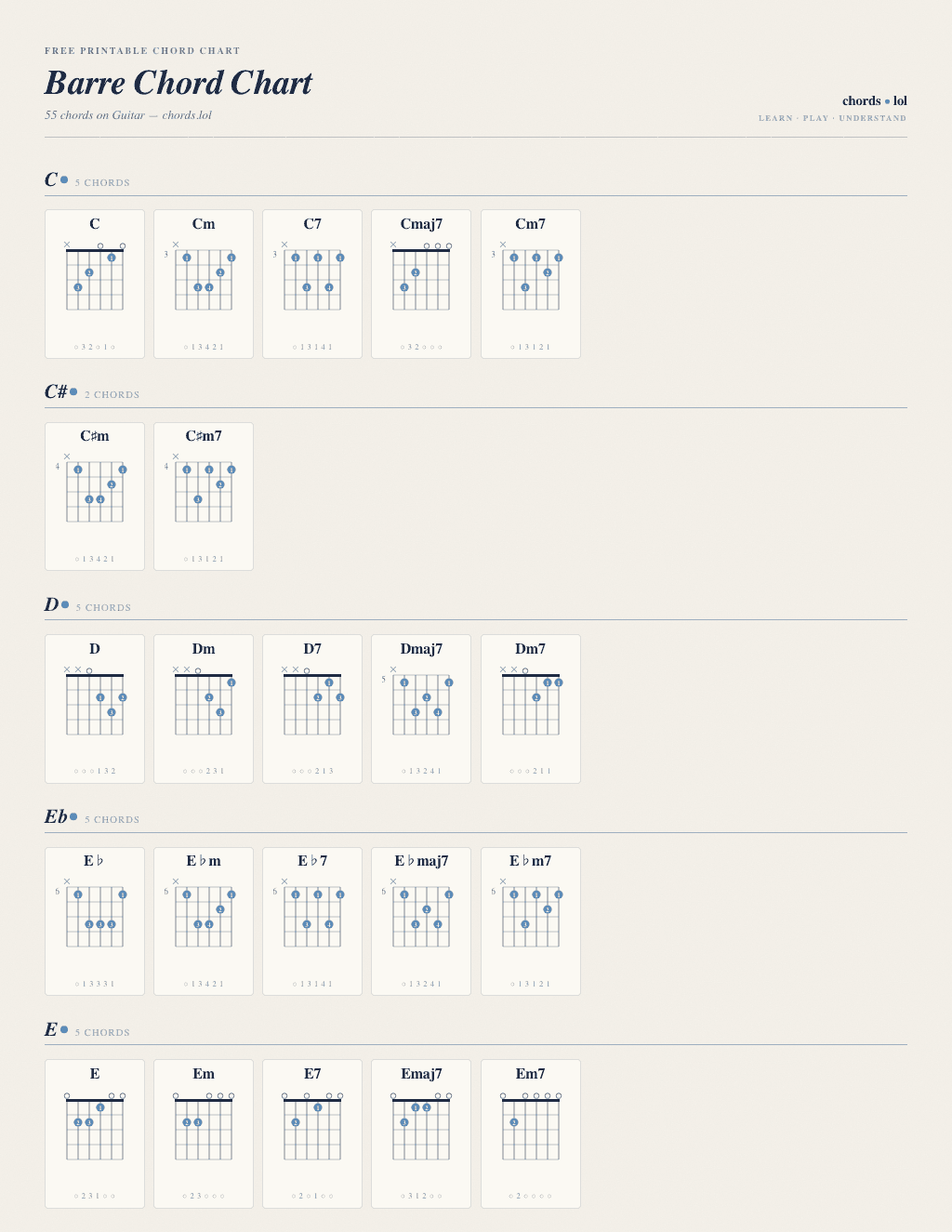
Barre chords unlock the entire neck. Once you know two shapes — the E-shape and the A-shape — you can play any major, minor, or seventh chord in any key by sliding your fretting hand to the right fret. This chart documents both shapes across all 12 keys.
The trick is finger strength and placement. The barring finger (typically the index) needs to apply consistent pressure across all six strings, which feels impossible for the first few weeks. The reward, when it clicks, is enormous: chords that took ten distinct shapes (every minor, dominant, and major variant) collapse into two shapes you slide.
We label each diagram with both the chord name and the fret number so you can use the chart as a transposition reference. Need to play the song in F# instead of F? Just slide the barre up two frets.
How to use it
Use the chart as a moveable shape reference. The E-shape and A-shape diagrams at the top show the fingering; the rows below show where to slide the shape for each root note. Practice transitioning between the two shapes at the same fret (e.g., F major E-shape ↔ F major A-shape — both are F major, different voicings).