About this issue
Why this chart.
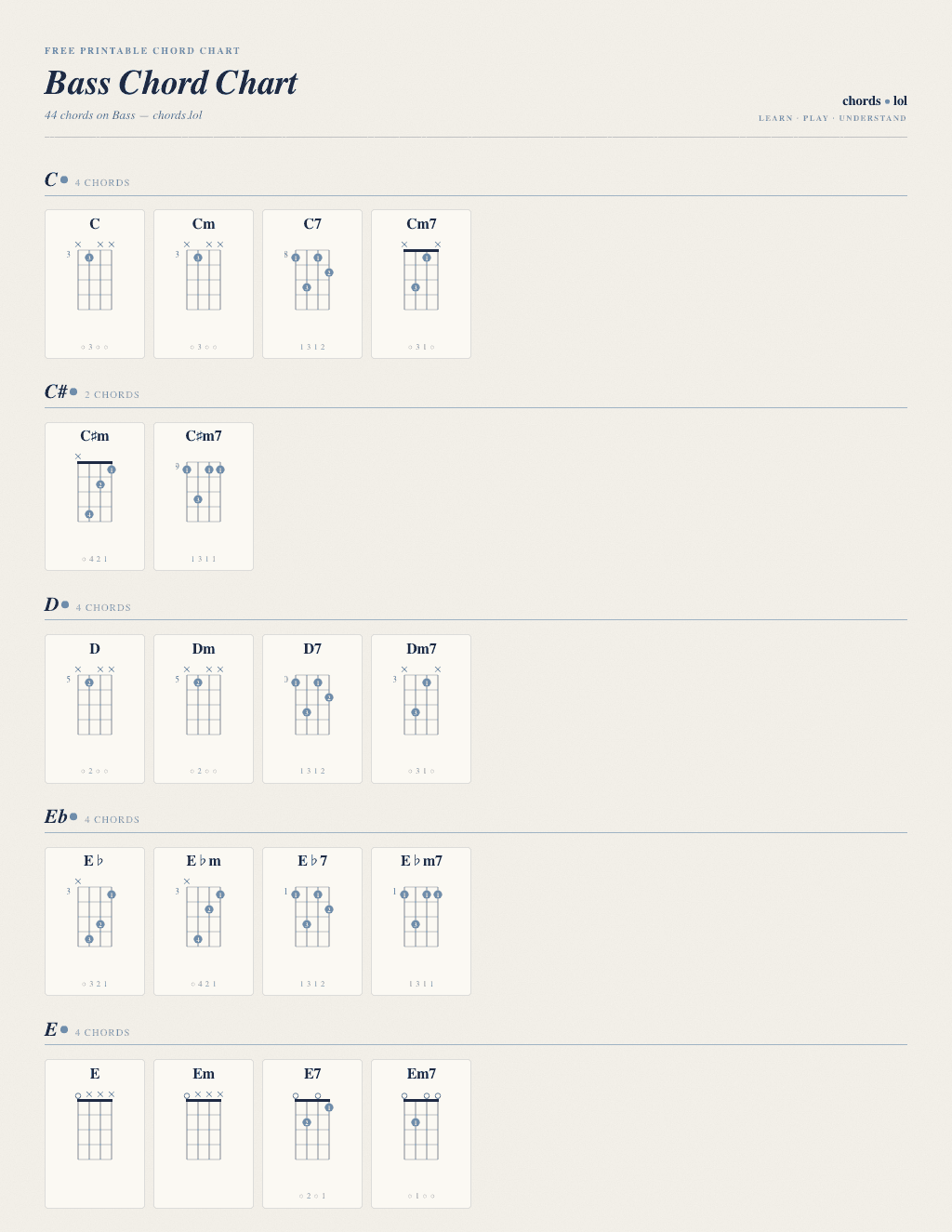
Bass chord charts are unusual because bassists rarely play full chords. The instrument's role is to anchor the bottom of the harmonic spectrum, so most basslines are single notes outlining the chord. That said, two-note 'power dyads' and arpeggios are bass vocabulary, and this chart documents both.
The chart shows root and fifth dyads (the bass equivalent of a power chord), root-third intervals (the harmonic anchor of any chord), and arpeggio patterns for major, minor, dominant 7th, and minor 7th chords.
We color-code by root note for visual scanning. Print the chart and use it when you're trying to outline a new chord progression on bass. Once you can play the root + fifth + arpeggio of any chord, you can fake your way through almost any session.
How to use it
For each chord in your song, play the root on beat 1 (and 3, in 4/4 time). Add the fifth on beat 2 (and 4) to outline a basic dyad. As you progress, add arpeggios — playing the chord tones in sequence rather than simultaneously.