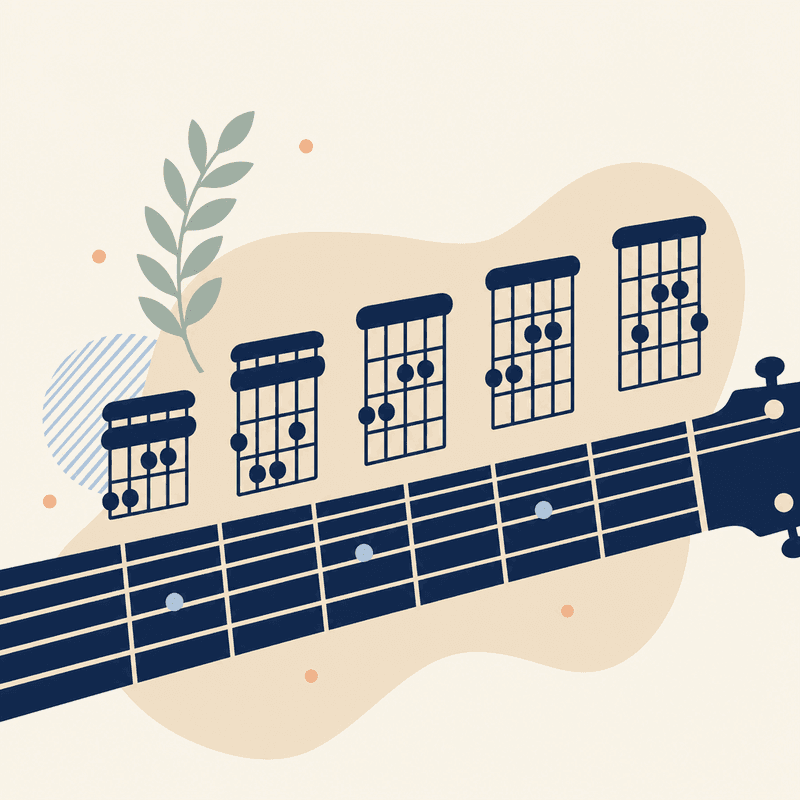
You know C, A, G, E, and D — and then someone calls a B♭ and your hand floats up the neck with nowhere to land. The fretboard past the third fret is fog.
In ~8 minutes you'll be able to:
- Find any major chord in five places on the neck
- Build your first barre chord from the E shape, one step at a time
- Turn any major shape minor by moving one finger
You'll need: the five open chords above. If any feel shaky, detour to How to Read a Chord Chart first.
Five shapes are the whole system
CAGED clears the fog. Slide any of your five open shapes up the neck — with a barre standing in for the nut — and it becomes a new chord with the same fingering. Five shapes, twelve roots each: sixty positions, and you already know the hard part.
Not a memorization trick. A way of seeing.
One chord, five places on the neck
Take C major. A voicing is one specific arrangement of a chord's notes on the fretboard — same chord, different spot, different color. C major has five:
| Shape | Fret | Character |
|---|---|---|
| C-shape | Open | The C you already play |
| A-shape | 3 | Full, grounded |
| G-shape | 5 | Big stretch, big ring |
| E-shape | 8 | Fat and resonant |
| D-shape | 10 | High, sparse, sustaining |
Read the first column top to bottom: C-A-G-E-D. That's the name — the order the shapes appear as you climb, for any chord in any key.
Each voicing's top notes overlap the next one's bottom notes, so the five link into a chain. You can glide between them without lifting your hand far.
Why this order?
The root of each shape sits a fixed distance above the previous root, and the pattern wraps around past fret 12. Fixed pattern, any key — that's why the system works.
Your index finger is a movable nut
Most CAGED guides jump from "open E chord" to "F barre chord" in one breath. That's the move that breaks beginners, so here's the slow version.
- Play your usual open E major — most people use fingers 1, 2, and 3. Now play the same chord with fingers 2, 3, and 4 instead. Same notes. Same shape. You've just freed your index finger.
- Slide the whole shape up one fret. Fingers 2, 3, and 4 are now at frets 2, 3, and 3. The strings that used to be open are dangling.
- Lay your index finger flat across all six strings at fret 1. That barre is the new nut — everything shifts up one fret because your index finger replaced the bone at the top of the neck.
You're playing F major.
Slide the same grip up two more frets and it's F♯. Three, G. Five, A. The shape never changes — only where the barre lands. The A-, G-, and C-shape barres convert the same way: refinger, slide, barre. The D-shape only covers the top strings, but the principle is identical.
Your hand will complain
The side of your index finger will burn for the first couple of weeks — that's hand muscle learning a new job, and it passes. Keep sessions short and daily. The full technique guide, buzz fixes included, is Barre Chords.
Flatten one note and every shape turns minor
The difference between major and minor is one note: the third. Listen to the swap.
One half-step down. Whole different mood.
To make a CAGED shape minor, find its third and pull it back one fret. Two shapes do nearly all the work:
- E shape → Em. Lift your finger off the third string — G♯ becomes open G. That's Em. Barre it at fret 3 and you have Gm.
- A shape → Am. Pull the second-string C♯ back one fret to C. That's Am. Barre it at fret 3 and you have Cm.
The C-, G-, and D-minor shapes exist too, but they're awkward under the hand and rare in the wild — the two above will carry you.
Five major voicings, five minor. The fretboard just doubled.
Five places to put a B♭
You're backing a singer in B♭ and the standard fret-1 barre sounds boxy. CAGED gives you four other places to land.
| Shape | Fret | Character |
|---|---|---|
| A-shape | 1 | The standard B♭ barre — full, grounded |
| G-shape | 3 | Awkward reach, rich sound |
| E-shape | 6 | Fat and resonant |
| D-shape | 8 | Sparse and sustaining |
| C-shape | 10 | High, bright, sparkles |
A working guitarist picks the voicing that fits the moment: the song's register, the singer's range, whichever shape reaches the next chord without a leap. CAGED is the map that makes the picking instant.
One chord a week, ten minutes a day
A month of that and the neck stops being a maze.
- Pick a target chord — start with A major. Play it in all five shapes, slowly: A-shape open, G-shape at fret 2, E-shape at 5, D-shape at 7, C-shape at 9.
- Connect neighboring shapes through a shared note — the root or the fifth — and roll your hand through it.
- Ask, in each shape: which note is the third? Flatten it and play the five A minor voicings too.
- Next week, a new chord: D, then C, then E.
Three ways this goes wrong:
Learning all twelve chords at once. Spread that thin, you lose the pattern — one chord, five shapes, both qualities, then move on.
Skipping the barre work. The hand pain ends; the fretboard freedom doesn't.
Drilling charts instead of playing music. Pick a key, start the metronome, and improvise through the shapes in order until they stop being diagrams and start being places.
The same five zones hold your scales
Each CAGED shape anchors a zone of the neck where the chord, its scale pattern, and its arpeggio all share the same few frets. Drop into whichever zone is under your fingers and you already know the safe notes. Start with the pentatonic scales — five-note patterns that fit cleanly inside each CAGED box.
Do I need all five CAGED shapes?
Not right away. The E and A shapes do most of the real-world work — they're the two barre-chord families — and the D shape covers high voicings. Get E and A automatic first, add D, and treat the C and G shapes as color you pick up later.
Does CAGED work for minor chords?
Yes — flatten the third in any shape and it turns minor. In practice the Em and Am shapes carry almost everything, because the barred C-, G-, and D-minor forms are awkward under the hand. Two minor shapes plus five major shapes covers the neck.
Is CAGED only for guitar?
Yes. It's a consequence of standard tuning — E-A-D-G-B-E is what makes those five open shapes tile the neck in that order. Other tunings and other instruments have their own movable-shape logic, but the CAGED map itself belongs to standard-tuned guitar.
- Intervals Explained — why the third is the chord's mood switch
- Voice Leading Explained — choosing the voicing that connects to the next chord
- Guitar Chord Chart — every chord, every CAGED variant
That's the trade.
Five shapes you already know, in exchange for the entire fretboard.