A flawless chord shape with a stiff right hand still sounds wrong. A child recognizes Wonderwall in two bars — not by the chords, by the strum.
In ~8 minutes you'll be able to:
- Play the one pattern behind half the campfire songbook
- Keep time through rests with ghost strums
- Fake three genre feels — gallop, pummel, sway — with the same right hand
You'll need: a guitar and a pick. If counting beats feels new, skim note values and time signatures first.
Down is heavy, up is light
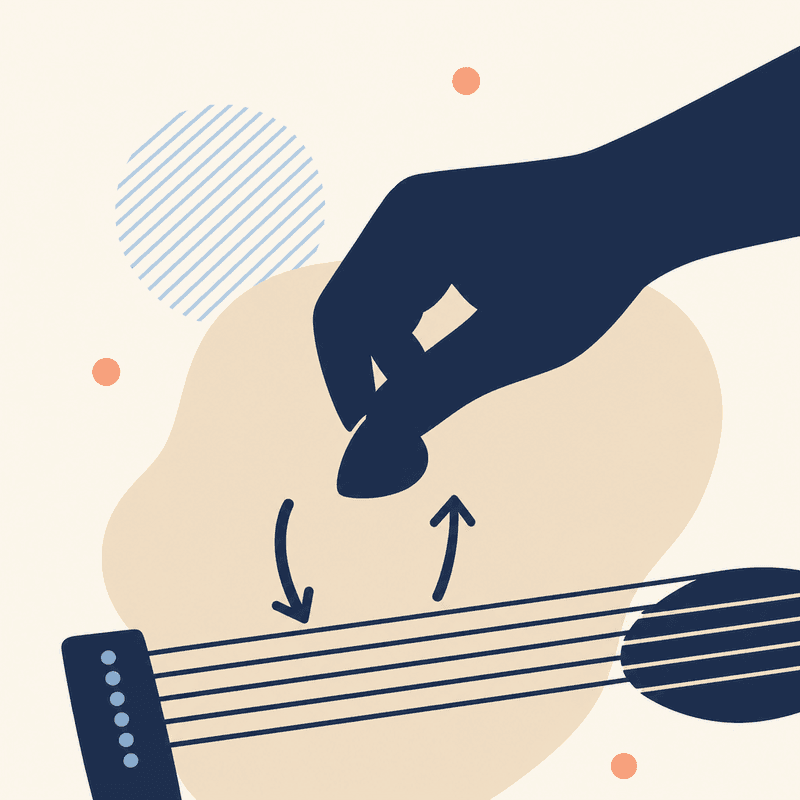
Down strums fall with gravity and hit the bass strings first — a thick whoomp that grounds the beat. Up strums fight gravity and catch the high strings first — a brighter chk that fills the space between.
Together they sound like a heartbeat. Thump-tick, thump-tick.
Every pattern below is built from those two motions and nothing else.
One pattern covers half the songs you know
Here it is. Each column is half a beat; count "1-and-2-and-3-and-4-and" and strum the arrows.
The all-purpose pattern
Drag the tempo down until it feels easy, then creep it back up.
Out loud it's "down, down-up, up-down-up" — six strums, spelled D-D-U-U-D-U. The faded slots are silent; they get their own section in a minute.
Notice the ups land on the ands — the weak halves of the beat. That's why the pattern leans forward instead of marching, the same lean Hey Soul Sister rides for its whole runtime.
Its relatives:
- Wonderwall — the campfire monolith
- Knockin' on Heaven's Door — same engine, half speed
- Country Roads — proof it survives any genre
If you only ever learn one strum, learn this one.
The hand never stops moving
Those underscores are not rests for your arm.
The hand keeps moving even when the strum is silent. On a ghost strum, the hand swings through in the right direction and the pick simply misses the strings. Watch any good player's strumming hand: it's a pendulum — downs on the beats, ups on the ands, contact optional.
The pulse lives in your body, not in the strings.
Stop the hand on a rest and you have to restart your timing for the next strum. That restart is the drift you hear in every beginner recording.
Try this: Play the all-purpose pattern once, then lift the pick away from the strings and air-strum it at the same tempo. The hand should look identical both times. If it stutters in the air, the strings were keeping time — not you.
Genre is which beats get the love
Same two motions, different slots.
Folk and country
The all-purpose pattern is the folk strum — dig the pick into the bass strings on the downs, brush the top strings on the ups.
It gallops.
- Wagon Wheel — the canonical lope
- I'll Fly Away — same horse, older trail
Rock and punk
Eight down-strokes
Eight downstrokes per measure, no subtlety, no breath. Your forearm burns — the fatigue is part of the sound.
It pummels.
- Back in Black — muted, menacing chug
- Blitzkrieg Bop — downstrokes as a lifestyle
Reggae
The skank
The downbeats are silent — bass and drums own them — and the guitar answers with a clipped chk on every and. Cut each chord short with the fretting hand; a long ringing reggae upstroke sounds wrong instantly.
It sways.
- Three Little Birds — the gentle skank
- Stir It Up — same sway, slower burn
Funk
Funk runs the ghost-strum trick at sixteenth-note speed: the hand moves sixteen times a measure and only a flickering handful make contact — Le Freak is the reference recording. Park it until the eighth-note patterns run on autopilot.
Sixteenth-note funk
Nine strums, sixteen hand movements. The gaps are the groove.
Technique is four fixes
- Wrist, not elbow. Shake water off your fingertips — that loose flick is the motion. The elbow positions the hand over the soundhole; the wrist strums. White knuckles make white-knuckle tone.
- Angle the pick. Tilt it 10–30 degrees so it glides across the strings instead of plowing through them. Obsess over this for one week, then never again.
- Palm mute for contrast. Rest the side of your palm on the strings just in front of the bridge: less ring, more chunk. Smells Like Teen Spirit mutes the verses and releases the chorus — the oldest dynamic trick in rock, and it still works.
- Play three volumes. Soft is the pick's tip, medium is your normal attack, loud is pick-deep with more wrist. Verse soft, chorus loud, bridge softer than everything: pop-song architecture in one sentence.
One volume sounds robotic. Three volumes sound like a song.
Fingerstyle — Travis picking, classical arpeggios, indie fingerpicking — is a different right-hand vocabulary built on the same rhythmic skeleton, and it deserves its own guide.
Practice is minutes, not secrets
- One pattern, one chord, five minutes a day. The all-purpose pattern on Am or G, click at 70. No chord changes — this is the step everyone skips, and it's why their strumming stays stiff. 70 BPM
- Add a second chord. Two bars of G, two bars of C, and the strum never stops. Changing chords without disturbing the right hand is the single most important skill on the instrument.
- Record yourself. Thirty seconds on your phone, then listen back. Playback catches the drift your ears excused in real time.
- Copy a real song. Play along with the actual recording of Wonderwall or Three Little Birds and match it exactly — faster than any tutorial.
Why does my strumming stall every time I change chords?
Because the left hand is interrupting the right. Keep the strum going even if the new chord lands half-fretted for a beat — clean chords catch up, but a stopped groove never does. Practice the change at a tempo slow enough that the hand never has to pause.
How do I stop speeding up?
Practice with a metronome and record yourself — rushing is invisible while you play and obvious on playback. Most speeding-up comes from the hand pausing on rests and then lunging to catch up. Ghost-strum through every silent slot and the tempo holds itself.
Am I supposed to hit all six strings on every strum?
No. Downs naturally favor the low strings and ups brush only the top three or four — that contrast is what makes a strum breathe. Aim for the middle of the string set and let the pick's momentum decide the edges.
- Chord Progressions Explained — something worth strumming
- How to Practice Effectively — structure the five minutes
The right hand is the heartbeat of the instrument. Get it pumping reliably and the rest of the body falls in line.