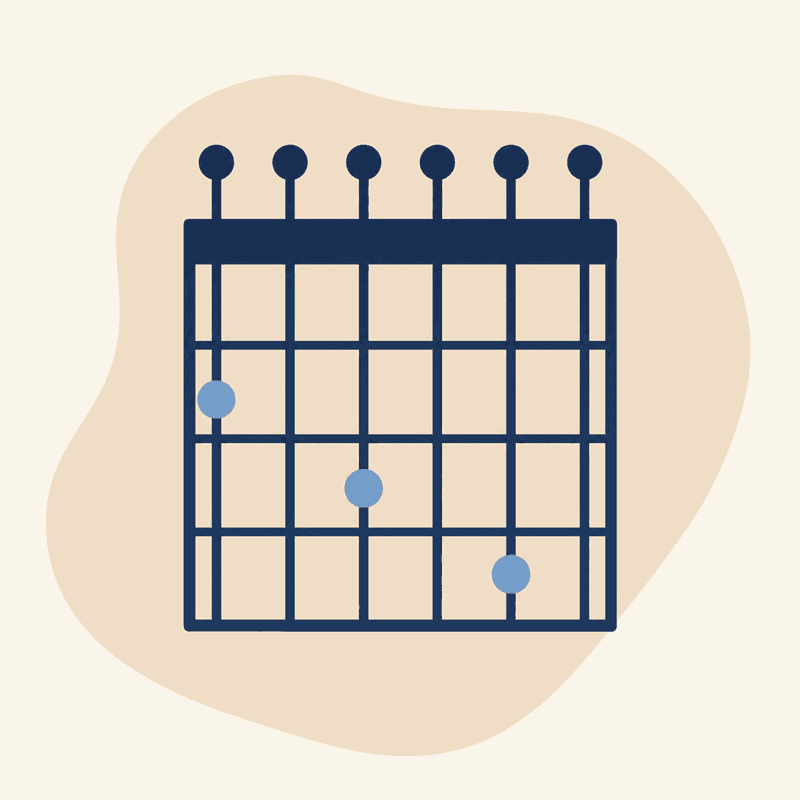
Most beginners stare at a chord chart like it's a circuit diagram. It isn't — it's a photo of your fretting hand, taken from above, drawn on a six-line grid. The whole vocabulary fits in an afternoon.
In ~6 minutes you'll be able to:
- Read any guitar chord diagram — strings, frets, dots, X and O
- Decode chord names like Cm, Cmaj7, and C/E
- Handle barre lines, "3fr" markers, and capo instructions
You'll need: nothing. A guitar within reach helps.
The chart is a photo of your fretting hand
Hang the guitar on a wall and step back. That's the view every chart draws.
- Vertical lines are strings. Low E — the thick one — on the left, high E on the right.
- Horizontal lines are frets. The heavy top line is the nut; fret 1 sits just below it.
- Dots show where to press. Each dot lives between two fret lines.
- Numbers inside the dots are fingers. 1 = index, 2 = middle, 3 = ring, 4 = pinky.
- X and O above the grid report string status. X: mute that string. O: strum it open.
That's the entire grammar.
Read it low to high: mute the low E, ring finger at fret 3, middle at fret 2, G open, index at fret 1, high E open. Strum. That's a C.
Two more shapes, same grammar — read them without help, then press play and check yourself.
Ukulele, mandolin, banjo, and bass charts speak the same language with fewer lines.
The chord name is a compressed sentence
The label above the diagram packs a recipe into a few characters. Six names cover most songbooks:
| Name | Decoded | Sound |
|---|---|---|
| C | C major — no suffix means major | Settled |
| Cm | Minor — the m flats the 3rd | Sad |
| C7 | Dominant 7 — major plus a flat 7th | Bluesy |
| Cmaj7 | Major 7 — major plus a natural 7th | Dreamy |
| Csus4 | Suspended — a 4th replaces the 3rd | Unresolved |
| C/E | Slash chord — C major, E in the bass | Walking |
Every suffix is one or two intervals doing emotional work; intervals is where the math lives.
The slash chord deserves one more beat, because it looks like a typo.
The left half is the chord. The right half is the foot.
C/E is C major with E as its lowest note. Walking the bass under a still chord gives a song motion you feel but can't name — the descending line in In My Life is this trick, start to finish.
Barre lines and "3fr" take the grammar up the neck
A thick bar or curve across the strings means one finger — almost always the index — lays flat across all of them at once.
The index barres all six strings at fret 1; the other fingers build the rest of the shape on top. Lay it flat with the knuckle behind the neck and weight from the arm — the grip should feel structural, not muscular.
Higher up the neck, the chart shows only a small window and prints the starting fret beside it. "3fr" means the top line of the grid is fret 3, not the nut.
"3fr" is the difference between a G major and a wrong shape entirely.
A capo moves the nut, not the rules
A capo clamps every string at one fret, so your "fret 0" moves up the neck. Capo 3, play in G means: clamp fret 3, then play your familiar G-shape chords against the capo. Your fingers get the easy shapes; the audience hears B♭, three semitones up.
Charts inside capo'd songs show shapes relative to the capo — "G" means the G shape at the capo, not a concert-pitch G. When the math tangles, the transposer converts between capo position and real key in either direction.
Piano charts name notes, not positions
A piano chart highlights keys on a small drawing of a keyboard: play the highlighted keys, you have the chord. The naming rules are identical to guitar. Three things shift in translation:
| Guitar chart | Piano chart | |
|---|---|---|
| Where to play | "Fret 3 on the A string" | "Play E" — note names, no positions |
| Slash chords | Same shape, different bass string | Lowest highlighted key is the slash note |
| Finger numbers | 1 = index through 4 = pinky | 1 = thumb through 5 = pinky |
On piano, 1 is the thumb. A chart marked 1-3-5 means thumb, middle, pinky — not index, ring, and a phantom sixth finger. Check which numbering system a chart uses before trusting it.
Knowing note names cold is the price of admission at the keyboard; beginner piano covers the layout end to end.
Expect 4–8 chord changes per minute at first
Beginners see eight chords on a page and assume they owe the song full tempo, first try. Reset that expectation.
While the shapes are still wiring into your hand, 4–8 changes per minute is normal — one change every eight to fifteen seconds.
Painfully slow on the inside; completely normal on the outside.
The skill being trained isn't reading. It's the bridge between seeing "G" and your hand already moving — and that bridge is built by reps, not effort.
Try this
Pick a song you know cold, put the chart in front of you, and play along with the recording. Ignore tempo and tone — just land each printed name as a shape before the recording moves on. Once the changes smooth out, a slow metronome keeps you honest.
Songbooks add five conventions on top
Beyond the diagram itself, songs reuse a small set of layout shorthand:
- Chords above lyrics — change on that syllable, hold until the next name.
- Bar lines — vertical lines separate measures; usually one chord per bar.
- Repeat signs —
||:opens a repeated section,:||closes it. - Multipliers — "x4" means play that bar four times.
- Strum arrows — ↓ downstroke, ↑ upstroke; p i m a marks fingerstyle thumb, index, middle, ring.
None are universal — every songbook invents a little dialect — but these five show up almost everywhere.
How long until I can read a chart at song tempo?
After a week of returning to the same handful of chords, you'll manage a few changes per measure. After a month the chart feels like training wheels — you glance at 'G' and your hand is already there.
Two charts show different fingerings for the same chord. Which is right?
Both. Most open chords have two or three workable fingerings, and songbooks print whichever their arranger prefers. Follow what the chart prints until the shape is automatic, then swap fingerings to smooth your changes — the fingering that flows into the next chord is the right one.
What is the difference between X and O on a chord chart?
X means mute the string: keep it from ringing by brushing it with a spare fretting finger or skipping it in the strum. O means play the string open, untouched. Both sit above the grid, one symbol per string, low E on the left.
What does '3fr' next to a diagram mean?
The top line of the grid is fret 3 instead of the nut, so the whole shape slides up the neck. Without the marker, the same fingering played at the nut produces a different chord.
Keep reading: Chord Progressions Explained for what to do with the chords you can now read, Beginner Guitar for the full on-ramp, and free printable charts to tape to your wall.
Don't study chord charts. Play songs that use them.
Knockin' on Heaven's Door — four shapes, forgiving tempo. Three Little Birds — three chords, zero hurry. Stand By Me — one loop, the whole song.
After a dozen songs, you stop reading the chart and start seeing through it.