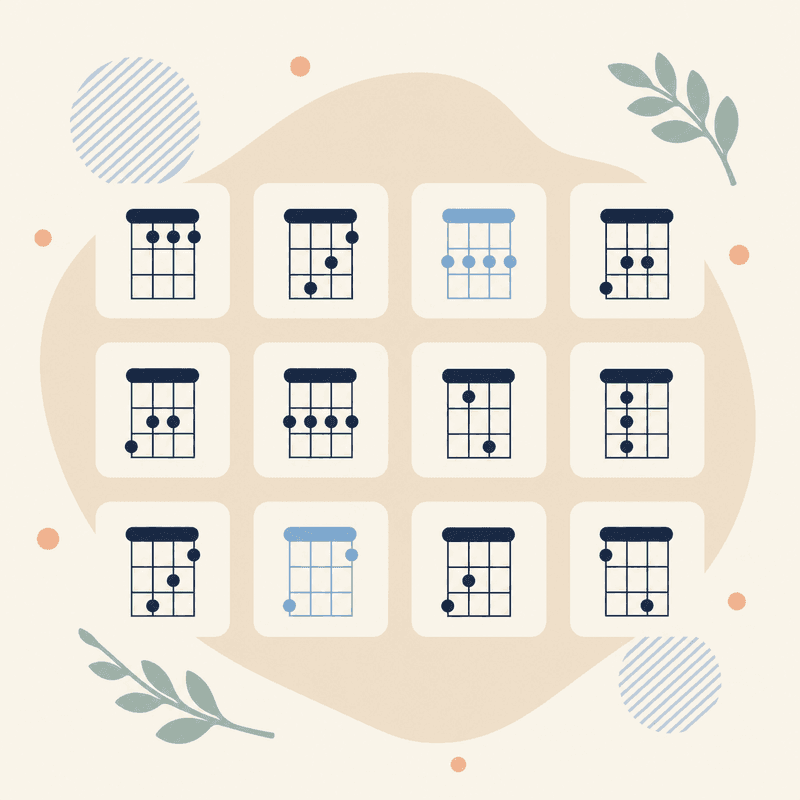
More songs follow the 12-bar blues than any other progression in popular music. Johnny B. Goode, Hound Dog, and Folsom Prison Blues are the same twelve bars wearing different clothes.
In ~6 minutes you'll be able to:
- Play the whole form in A, E, or C
- Hear why a 7th on every chord is the blues sound
- Write a twelve-bar verse of your own
You'll need: Chord progressions if Roman numerals (I, IV, V) feel new. Otherwise, nothing.
The whole form fits on an index card
Twelve bars. Three chords — I, IV, V. Here's the entire skeleton:
| I  | I  | I  | I  |
| IV | IV | I  | I  |
| V  | IV | I  | V  |
Three lines of four. Line one sits on home. Line two visits the IV and comes back. Line three climbs to the V and falls home — that last V is the turnaround, kicking you back to the top.
Read it left to right, top to bottom. That grid has been running pop music since the 1920s.
Three keys cover almost every blues
The chords change with the key. The shape doesn't.
| Key | I7 – IV7 – V7 | Who lives there |
|---|---|---|
| A | A7 D7 E7 | Guitarists — open strings ring everywhere |
| E | E7 A7 B7 | Stevie Ray Vaughan — Pride and Joy lives here |
| C | C7 F7 G7 | Piano players — easy on keys, harder on guitar |
Pick one and loop it. Here it is in A, three shapes and twelve bars:
12-bar blues in A
Straight sounds like rock. Shuffled, it's blues — flip the toggle mid-loop and hear the form change genre.
Every chord gets a 7 — and that's the whole sound
You don't play I, IV, V in a blues. You play I7, IV7, V7. Every chord is a dominant 7th.
That's rule-breaking. In normal Western harmony — pop, classical, folk — only the V gets a dominant 7; the I and IV stay plain triads. Putting a 7 on every chord breaks functional harmony — and is exactly what makes blues sound like blues.
A dominant 7 is a major triad with a flat 7 on top: A7 is A + C♯ + E + G. Hear what the G does.
That flat 7 builds tension into every chord. Every chord wants to resolve. Nothing ever fully sits down — and that off-balance feeling is the sound of blues.
A regular I–IV–V sounds polite. A I7–IV7–V7 sounds like Robert Johnson selling his soul.
The lyrics are twelve bars too
The chord form pairs with a lyric form: A-A-B. Statement, repeat, punchline — three lines, four bars each.
I woke up this morning, blues all around my bed (A — over the I) I woke up this morning, blues all around my bed (A again — over IV → I) Went to eat my breakfast, blues all in my bread (B — over V → IV → I)
The repeat isn't laziness. It buys you four bars to think of the punchline.
Once you hear A-A-B, you'll catch it on every blues record made before 1965 — and most made after.
Every blues bends the form a little
Quick-change: bar 2 becomes IV7. A quick visit before settling back in.
| I  | IV | I  | I  |
| IV | IV | I  | I  |
| V  | IV | I  | V  |
Sweet Home Chicago is a quick-change. So is most '50s Chicago blues.
Minor blues: the I and IV go minor; the V stays dominant for the pull home.
| im7 | im7 | im7 | im7 |
| ivm7| ivm7| im7 | im7 |
| ♭VI7| V7  | im7 | V7  |
The Thrill Is Gone (BB King) is the canonical minor blues — same twelve bars, but the floor drops out.
There's also jazz blues: ii–V's and substitutions in every bar, same skeleton underneath. Don't learn it yet — get this form under your fingers first, then come back through functional harmony.
One scale covers all twelve bars
The reason every guitarist learns blues first: you can solo over the entire form with one scale.
The minor pentatonic works over every chord. Add the ♭5 — the blue note — and you've got the blues scale.
Six notes, infinite vocabulary.
A BluesIn A, that's A–C–D–E♭–E–G. You don't change scales when the chords change. Play the scale and trust your ear.
Where the blue note lives
Try this: hit the ♭5 (E♭ in A blues), then bend up to E — the perfect 5th. Dissonance, then release. Half the licks in Pride and Joy are some version of this move.
Shuffle it or it isn't blues
A blues isn't played straight. Each beat splits long-short — DUH-da DUH-da — a triplet lope called the shuffle.
Play the twelve bars straight and they sound like rock. Shuffle them and they sound like blues.
The page says 4/4; the feel is closer to 12/8. When you strum, let the up-stroke land late, and check yourself against a metronome until the lope feels lazy on purpose.
A century of hits, same twelve bars
Once you see the form, you can't unsee it.
| Song | Artist | Year | Why it matters |
|---|---|---|---|
| Sweet Home Chicago | Robert Johnson | 1937 | The template every blues musician knows |
| Rock Around the Clock | Bill Haley | 1954 | The first rock and roll #1 |
| Folsom Prison Blues | Johnny Cash | 1955 | Country and blues share more bones than either admits |
| Hound Dog | Big Mama Thornton, then Elvis | 1952 / 1956 | Same twelve bars twice — once raw, once sanitized |
| Johnny B. Goode | Chuck Berry | 1958 | The blueprint for rock and roll |
| Pride and Joy | Stevie Ray Vaughan | 1983 | E blues, shuffled, every solo inside the form |
Pick any BB King, Albert King, or Buddy Guy record and count to twelve.
Write one tonight
Pick a key — A or E on guitar, C on piano. Loop the twelve bars at any tempo: slow shuffle, medium walk, fast jump.
Sing one line. Sing it again. Land the punchline. Don't worry about rhyme or meter — the form does the heavy lifting; your job is the truth in the lyric.
Stuck? Write about the day you're having. Woke up. Coffee was cold. Boss called. The blues canon is full of songs about nothing more interesting than that.
The form gives the complaint dignity.
When you've got a verse, write another. By the third you'll find a hook. By the fifth you'll have a song.
Why does every chord get a 7th in blues?
In most Western harmony only the V chord takes a dominant 7. Blues puts that tension on the I and IV too, so every chord leans forward and nothing fully settles. Plain triads work — they just sound polite instead of bluesy.
What's the difference between shuffle and straight feel?
Straight feel splits each beat into two equal eighth notes; shuffle splits it long-short, like the first and last notes of a triplet. Same chords, same bars — straight reads as rock, shuffle reads as blues. Loop both against a metronome and you'll hear it in two bars.
What scale do I solo with over a 12-bar blues?
The minor pentatonic of the key covers all twelve bars — in A blues, A minor pentatonic. Add the flat 5 for the six-note blues scale. You never have to switch scales when the chords change.
Keep going: Pentatonic scales · Strumming patterns · Chord progressions
The form has carried a century of careers, and it will carry your first verse tonight.
Pick a key. Loop the twelve bars. See what shows up.